


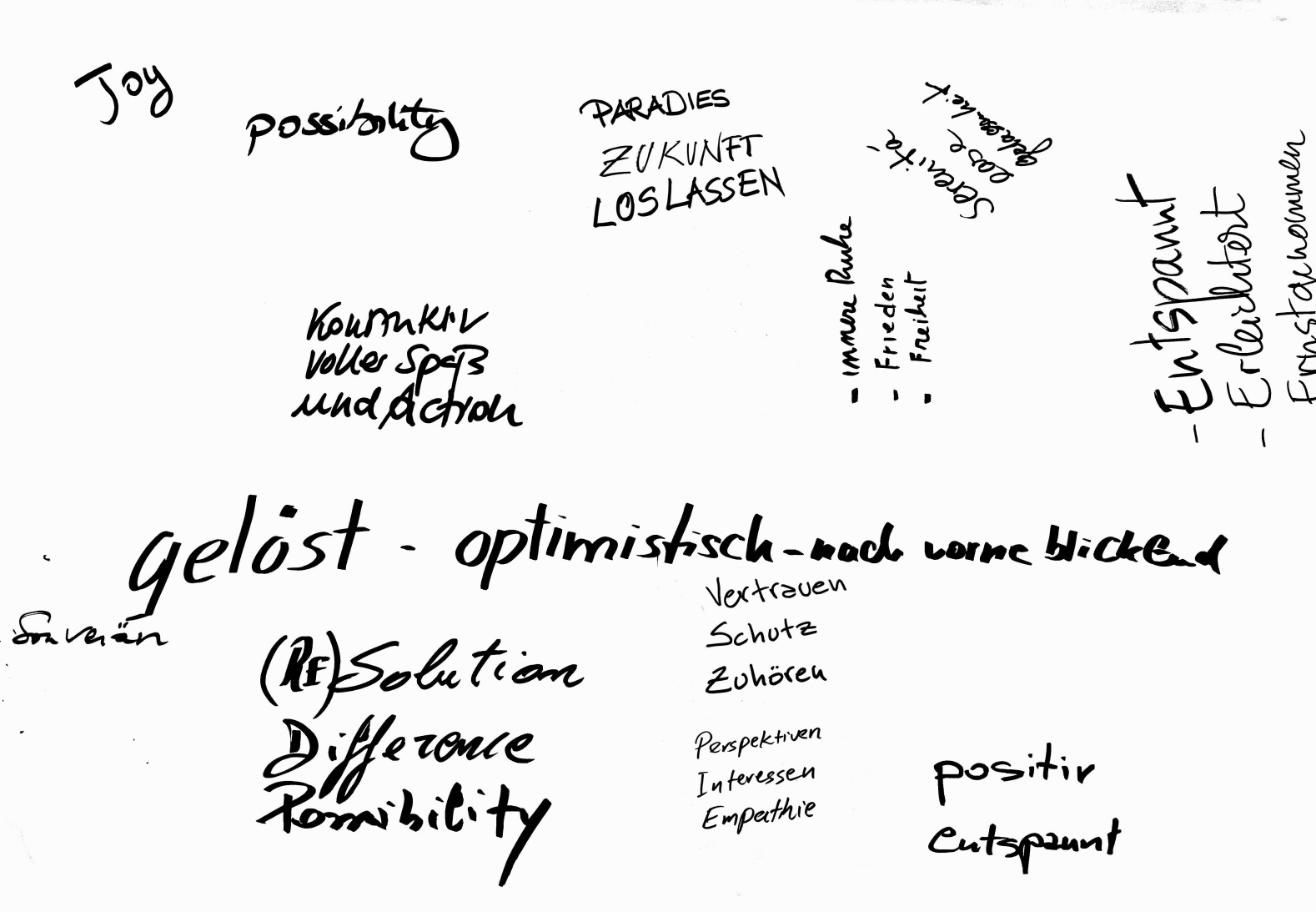
How ten people described living in a world where conflicts are resolved cooperatively — written in German and English, side by side, at the close of the session.
17.09.2026Programmes and CampaignsMedia for Peace
Let's talk about Conflict
At WERTE durch netzWERKE in Munich, Xchange Perspectives (XcP) talked with ten people about conflict — sixty minutes that began with each person's own experience and ended at a flipchart covered in words like trust, relief and possibility.
The hour began with a disagreement about a word.
Konflikt. Asked where conflict turns up in their daily lives, some in the room reached for it straight away. Others said Streit. Others said Kampf. Three words, three different weights — and before anything had been taught, the room had already found what the session is about: we do not all mean the same thing when we hear the word conflict.
From there it went private. Each person scored their own conflicts, at home and at work, from zero to five, on a sheet nobody else would see. Not a case study, not an example from the news. Their own week.
By the end of the hour, the room had arrived somewhere together. A conflict is, to begin with, only a situation. It belongs to life — a normal part of every relationship, including the good ones. Whether it becomes a Streit, or an opening to grow, is decided by what we do with it.
The method
The session drew on 'A Conversation About Conflict', a facilitated-awareness process developed by Search for Common Ground. In XcP's Media for Peace trainings and workshops, this conversation usually takes around 90 minutes, and it sits at the heart of conflict analysis.
Conflict is a relationship between parties who have, or believe they have, incompatible positions, interests or needs. Whether it turns violent depends on how it is approached. Treating the other party as the problem leads one way. Understanding what each side actually needs leads another — towards what we call transcendence, the point at which the differences themselves become the material for something new.
What they wrote
The hour closed at the flipchart, where everyone wrote their answer to the following question: How would you feel if you lived in a world where you could voice your feelings safely, where the real issues were dealt with, and resolutions were found, where everyone's voice was heard and respected.
The answers came in two languages, German and English, written over and across each other: Joy. Possibility. Vertrauen. Schutz. Zuhören. Innere Ruhe. Frieden. Freiheit. Entspannt. Erleichtert. Ernstgenommen. Konstruktiv, voller Spaß und Action. Gelöst — optimistisch — nach vorne blickend. Perspektiven. Interessen. Empathie. Difference. Possibility.
What people reached for was relief, trust, being taken seriously — and, more than once, possibility. That is the whole argument for approaching conflict cooperatively rather than adversarially, arrived at by ten people in under an hour, in their own words.
The session ended with a line from Antoine de Saint-Exupéry: Aimer, ce n'est point nous regarder l'un l'autre, mais regarder ensemble dans la même direction. Loving is not looking at one another, but looking together in the same direction.
Why Munich
Most of XcP's work has taken place abroad. The conditions that make conflict competence necessary — polarisation, hardening language, the certainty that the other side is the problem — are to be found everywhere. They are in schools, workplaces, community organisations and families across the world.
This is not the first time we have brought Media for Peace home. In 2017, XcP ran Practice Peace, a four-day Media for Peace workshop with artists at Munich's Kösk — the first time the framework was taught in Germany. What was an experiment then is becoming a strand of work.
Thank you
WERTE durch netzWERKE was a two-day event in Munich hosted by Working in Projects gUG.
It was a pleasure to meet, see and hear so many others working on the same questions from different directions: Fondazione Pistoletto Cittadellarte, the Bayerische Landeszentrale für politische Bildungsarbeit, Still I Rise Deutschland e.V. and Corriere della Sera among the inputs and performances; AGABY, the Bayerischer Flüchtlingsrat, Panafrikanismus München e.V., the Bayerischer Integrationsrat, the Münchner Migrationsbeirat, Rinascita e.V., MORGEN e.V. with the BEST-Projekt, the Petra-Kelly-Stiftung e.V., Münchner Freiwillige – Wir helfen e.V., Community Kitchen gGmbH, OMAS gegen Rechts München, Diakonie München und Oberbayern, GuteTat, Mala de Herança, Teatro Progetto 15 e.V. and our fellow members of the Nord Süd Forum München e.V. among the networks and civil society organisations; and from education and research, the Institut für Deutsch als Fremdsprache at LMU München, Werksviertel-Mitte with ALMSCHULE, the Leonardo da Vinci Schule and the Montessorischule Hohenbrunn.
Between the inputs there was music: Serena Chillemi at the piano, Serena and Tommaso Farinetti as MINIMAL DUO, Waseem — rapper and activist — opening Saturday, and the JFB-Band closing the evening.
Domenico Capanna and Martina Riescher ran reflection, awarness and improvisation exercises throughout the two days.
We look forward to continuing all the conversations we started.